
How to Measure a Cake for an Edible Wrap (Tin or Tape Measure)
Why “diameter × 3.14” leaves an edible wrap short, and two reliable ways to measure the iced cake instead, with round and square examples.
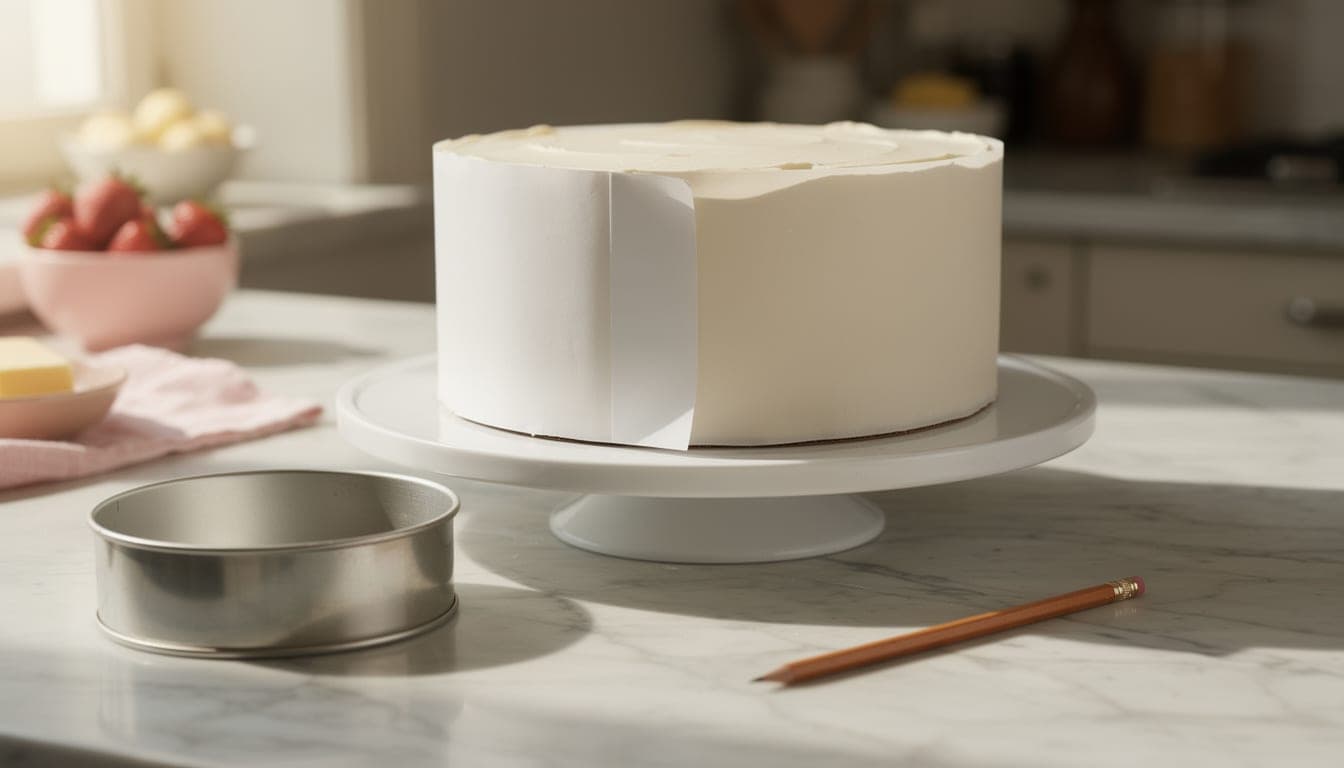
Why the usual sum comes up short
To measure a cake for an edible wrap, measure the cake as it will be once it is iced, not the bare tin. A wrap is a strip of icing sheet (a frosting sheet, in the US) that goes round the side of the cake. What matters is the distance round the finished cake, plus a small overlap where the two ends meet. The most reliable way is a tape measure round the iced cake. The other way is a short sum using the tin size and how thick your icing is.
The advice you will usually find is “diameter × 3.14, then add a bit extra”. It is not wrong, but it measures the tin, and “a bit extra” is left to guesswork. Icing is the missing piece. Buttercream, ganache or fondant adds thickness all the way round, so the cake is wider than the tin that baked it. Every 1 mm of icing adds about 6.3 mm to the distance round. On an 8″ round with a 5 mm coat, that is about 31 mm. A wrap cut to the bare tin is roughly 3 cm short and the ends will not meet.
A strip that comes up short can be rescued with a second strip of exactly the same height, as this Cake Central tutorial notes, but it is tidier to size it properly the first time.
What the icing adds: an 8″ tin as an example
Here is the same 8″ (203 mm) round tin at four icing thicknesses. Each length is the distance round the iced cake, before the overlap.
| Icing thickness | Length round the cake | Extra over the bare tin |
|---|---|---|
| Bare tin (no icing) | 638 mm | – |
| 3 mm | 657 mm | about 19 mm |
| 5 mm | 670 mm | about 31 mm |
| 10 mm | 701 mm | about 63 mm |
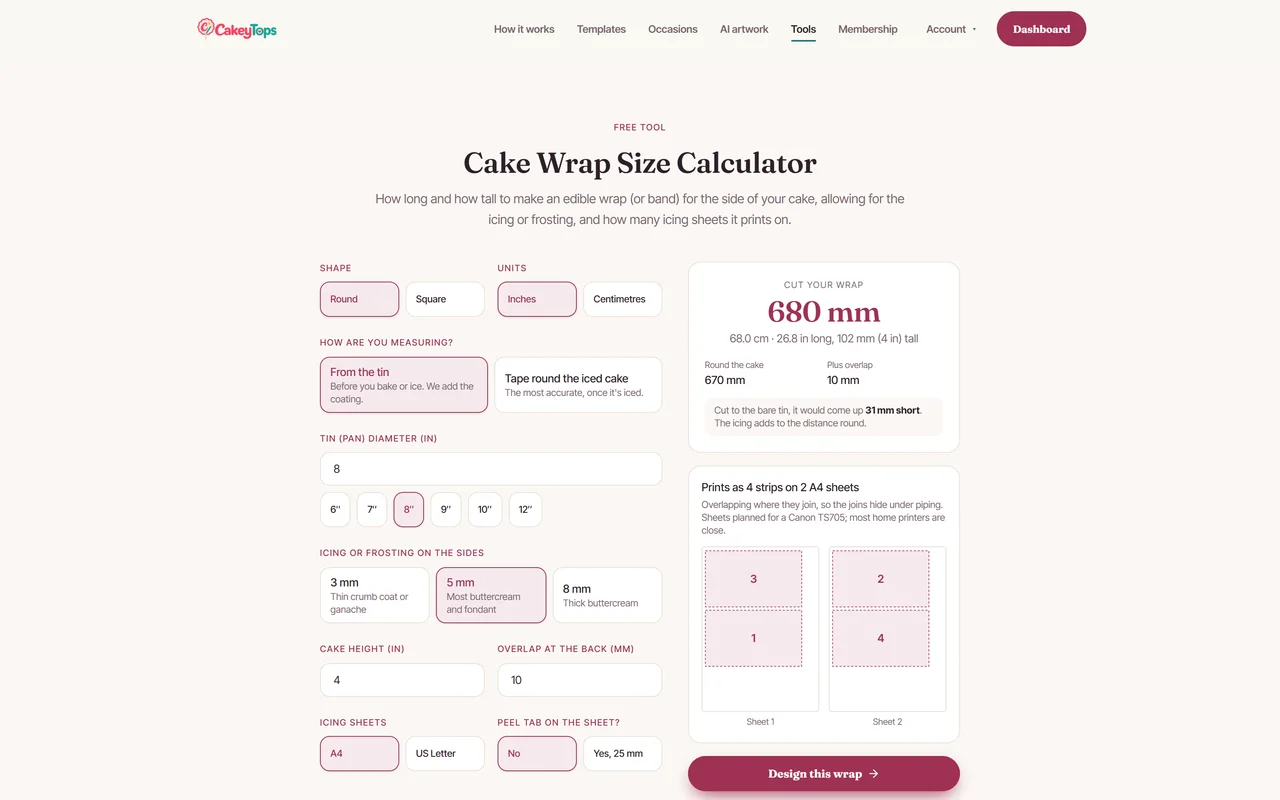
In the free calculator, 3 mm is labelled as a thin crumb coat or ganache, 5 mm as most buttercream and fondant, and 8 mm as thick buttercream. Both the calculator and the designer start at 5 mm. If you are not sure what your own coat comes to, ice a cake, measure the finished width across, take away the tin diameter and halve the difference.
How to measure a cake for an edible wrap: two methods
Method A: tin plus icing thickness
Use this when you need the wrap sized before the cake is iced, for example to print it a day ahead. The sum is:
length round the cake = π × (tin diameter + 2 × icing thickness)
The icing goes on both sides of the tin, which is why it is doubled. For an 8″ tin (203.2 mm) with 5 mm of icing, that is π × 213.2 mm, which comes to about 670 mm. Measure your tin across the inside rather than trusting the label. The free cake wrap size calculator does the sum for you, in inches or centimetres.
Method B: a tape measure round the iced cake
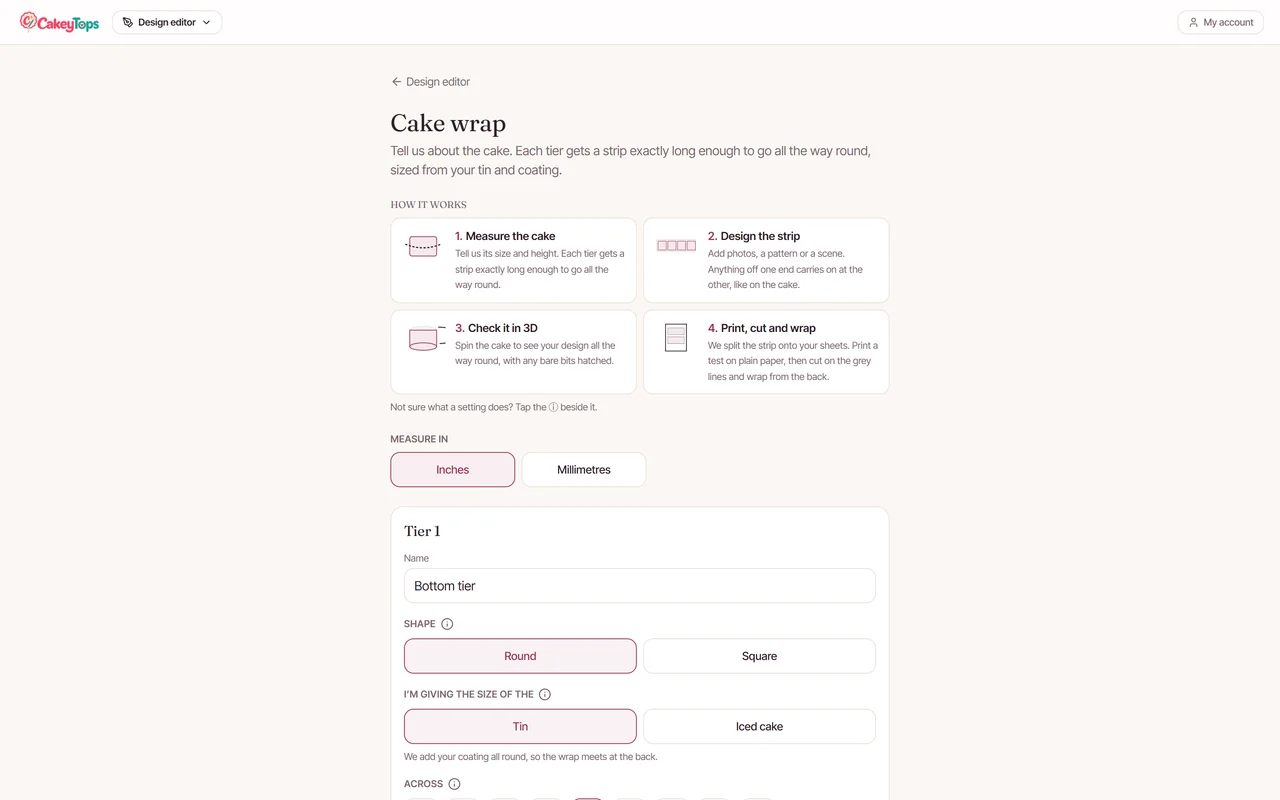
This is the most reliable method, because it measures the real cake, with the real icing, rather than an estimate. The designer accepts a tape measurement directly.
- 1
Ice and smooth the sides
Finish the icing first. A tape reading taken before icing is just the tin again. - 2
Use a soft tape or a length of string
Cake Central’s tutorial suggests string or a soft tape. A rigid metal tape will not follow the curve. - 3
Go round at the height the wrap will sit
Keep the tape level and flat against the icing, snug but not stretched. With string, mark where it meets itself, then lay it flat against a ruler. - 4
Enter it as the length round the cake
A tape reading already includes your icing, so do not add a coating allowance on top. Pick the tape option in the calculator or designer instead.
Measure the height after the top is smooth
Length is only half of it. The strip also needs a height, and a sponge measured before it is filled, layered and iced is not the height of the finished cake. Level and ice the top first, then measure the side from the cake board to the top edge.
Decide where you want the wrap to finish before you measure. Reaching the top edge looks clean. Stopping just short leaves room for a piped border or a few decorations. Either is fine, but a strip cut too tall is hard to fix, so measure to the point where you want it to stop. The designer’s 3D preview shows how much of the cake your design covers, so you can see this before you print.
Square cakes: allow for the rounded corners
Icing does not stay in a sharp right angle. It rounds off at the corners, and a wrap follows that curve. So a square cake is not simply four times the side. The sum is:
length round the cake = 4 × side + 2π × icing thickness
The four corners add up to one full circle of icing thickness. For an 8″ square tin with a 5 mm coat, that is 4 × 203.2 mm plus about 31 mm, or 844 mm. The extra at the corners is the same as on a round cake with the same coat. A tape measure helps here too: take it snugly into each corner rather than cutting across it.
There are ready-worked figures on the calculator’s size pages for 6″, 8″ and 10″ square cakes.
Why there is a 10 mm overlap
The designer adds a 10 mm overlap at the back by default, so the two ends meet under it. Ends almost never meet perfectly. The cake is not a flawless circle, an icing sheet can shift as you lay it, and a cut can wobble. A strip cut to the exact length shows any small error as a gap. An overlap puts the last end over the first, at the back of the cake, where it is hidden.
If you are cutting by hand rather than using the designer, add the overlap to your length yourself. In the calculator screenshot above, 670 mm round the cake plus 10 mm is the 680 mm to cut.
Do not confuse this with the 6 mm overlap where two printed pieces join on a long wrap. That is a separate allowance, there so the joins are hidden. The A4 printing guide covers it.
Printed lengths for common cakes
These figures use 5 mm icing, the 10 mm overlap and a 4″ tall wrap. The piece and sheet counts are the designer’s “fewest sheets” default on A4 sheets, using Canon TS705 margins.
| Cake | Round the cake | Printed (+10 mm) | A4 pieces / sheets |
|---|---|---|---|
| 4″ round | 351 mm | 361 mm | 2 / 1 |
| 6″ round | 510 mm | 520 mm | 2 / 2 |
| 8″ round | 670 mm | 680 mm | 4 / 2 |
| 10″ round | 829 mm | 839 mm | 3 / 3 |
| 12″ round | 989 mm | 999 mm | 6 / 3 |
| 8″ square | 844 mm | 854 mm | 5 / 3 |
A 4″ tall strip does not fit twice across A4 landscape. The planner therefore tries strips along and across the sheet and picks the fewest sheets. That is why a cake can need more pieces than sheets.
What we found: many icing sheets have a clear plastic peel tab across one end, and ink printed there smeared when we printed real wraps on a Canon TS705. That is why the designer now asks whether your sheet has one. With a 25 mm tab, the 6″ becomes 3 pieces on 2 sheets and the 10″ becomes 5 pieces on 3 sheets. The others do not change.
For other sizes, use the calculator’s pages for 4″, 6″, 7″, 8″, 9″, 10″ and 12″ round cakes. If you are making smaller toppers rather than a wrap, the edible image size chart has those.
Frequently Asked Questions
How do I measure a cake for an edible image wrap?
Measure the iced cake, not the tin. Run a soft tape or string round the finished cake at the height the wrap will sit, then add a 10 mm overlap. If you need the size before icing, use π × (tin diameter + 2 × icing thickness) instead.
How long should an edible wrap be for an 8 inch cake?
For an 8″ round tin with 5 mm of icing, the distance round the cake is about 670 mm, or about 680 mm to print with a 10 mm overlap. A 3 mm coat gives 657 mm round the cake and a 10 mm coat gives 701 mm, before the overlap.
Should I measure before or after icing the cake?
After, if you can. A tape measure round the iced cake is the most reliable method. If you have to print before icing, use the tin-plus-icing sum, and test it against the cake with a plain-paper strip.
How do I measure a square cake for a wrap?
Use 4 × side + 2π × icing thickness, which allows for the rounded corners. For an 8″ square with 5 mm of icing that is about 844 mm round the cake. Or take a soft tape snugly round the iced cake, into each corner.
My wrap came up short. What can I do?
Add a second strip of exactly the same height to fill the gap, as Cake Central’s tutorial suggests. Next time, size the wrap from the iced cake rather than the tin, since icing adds about 6.3 mm round for every 1 mm of thickness.
A tool for CakeyTops members. Enter your tin or tape measurement and it sizes the strip, then splits it across your A4 icing sheets.
Use the tool from this guide
Open the relevant CakeyTops tool and put the advice above to work straight away.
Keep reading
How to Print an Edible Cake Wrap on A4 Icing Sheets
A cake wrap is longer than any sheet, so it prints in pieces. Here is how the pieces overlap, where the joins go, and the print settings that stop a wrap coming out the wrong size.
TutorialHow to Put an Edible Wrap Round the Side of a Cake
A step-by-step guide to wrapping an icing sheet round a cake, from chilled buttercream or fondant to hiding the joins under piping.
GuideEdible Cake Wrap Problems: Won’t Peel, Bubbles, Too Short or Misaligned
A troubleshooting guide for icing sheet cake wraps: stuck backing, bubbles, a wrap that comes up short, a join that misses and smeared ink.