How to Make Edible Paint Palettes for PYO Cookies (Every Method Compared)
PYO cookies live or die on the paint palette. Here is every method bakers use to make edible palettes, why printed icing sheets win, and a generator for CakeyTops members that designs the print file for you.
8 min readBy CakeyTops Team
Paint-your-own cookies are the most fun product a cookie baker can sell — but the edible paint palette is where most people get stuck. Piping dozens of tiny icing dots takes all evening, sweets bleed into the icing, and gel paint stains mouths. Here is every palette method compared, and the one we recommend if you already own an edible printer.
What an edible paint palette actually is
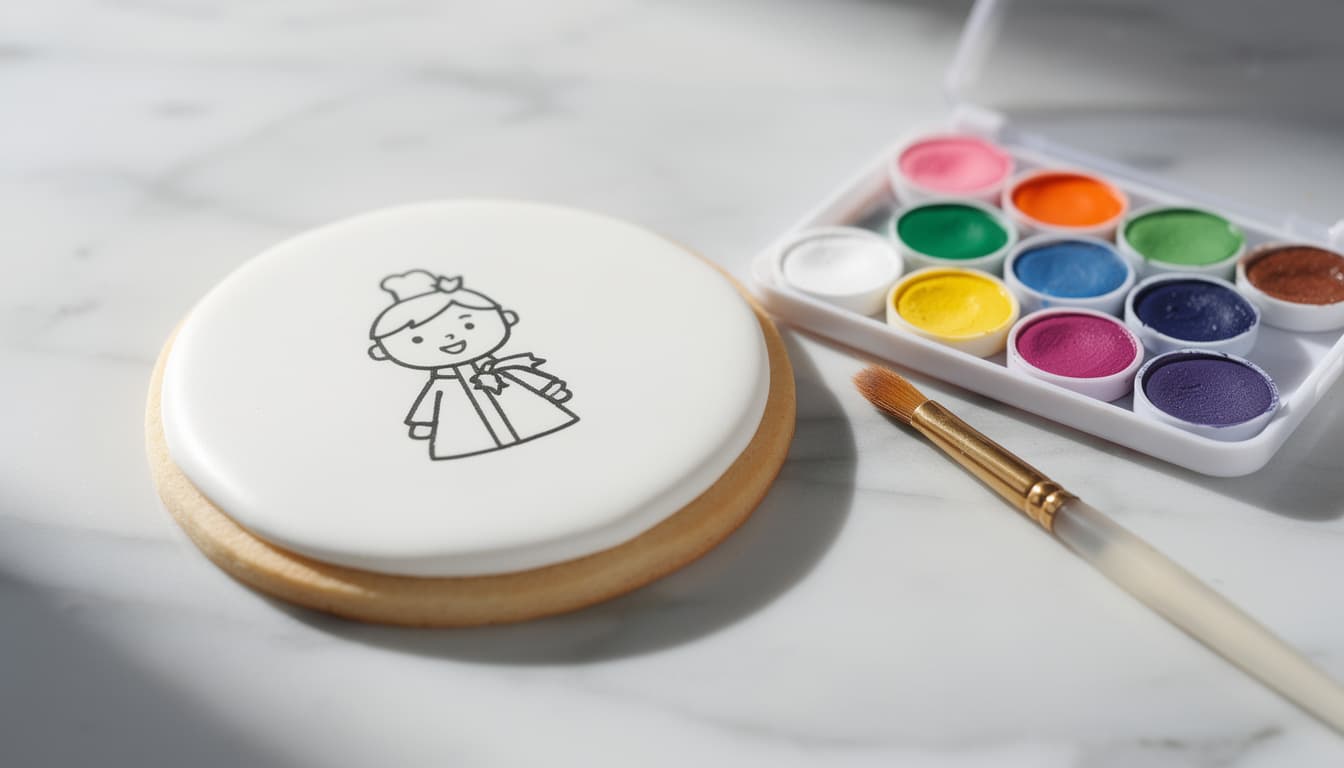
A PYO palette is nothing more than patches of very concentrated edible colour on an edible base. When a damp brush touches a swatch, the water re-activates the colour and the brush lifts it — exactly like a child's watercolour set. The customer paints the colouring-book outline on their cookie, and the whole palette is safe to eat.
Because the mechanism is watercolouring, two things decide whether a palette is any good: how much pigment each swatch holds, and whether the swatches survive packaging without bleeding. Every method below trades off speed against those two things.
The five palette methods, compared
Edible paint palette methods
Method
Time for 12 palettes
Colour quality
Verdict
Printed icing sheet
~10 minutes
Deep, identical every batch
Best all-round if you have an edible printer
Piped royal icing dots
2–3 hours + overnight dry
Good, varies by batch
Pretty but painfully slow at volume
Airbrushed dots over a stencil
~45 minutes
Medium depth
Decent middle ground, needs an airbrush
Sweets pressed into wet icing
~15 minutes
Strong at first, then bleeds
Fine for same-day parties only
Gel colour in pods
~30 minutes
Very strong, but bitter
Stains mouths — kids will find out
The printed icing sheet method, step by step
1
Design the palette
Open the PYO Paint Palette Maker, included with a CakeyTops membership. Pick a shape — classic artist palette with a thumb hole, watercolour-style paint pods, or a slim dot strip — choose 4–8 colours, and set the size. Most bakers use 2.5″ palettes for standard kits.
2
Check your colour depth
This is the step everyone skips and regrets. Light colours barely transfer to the cookie. The generator flags any swatch that will paint too pale and deepens it with one click, or start from a curated pack (brights, pastels, Christmas, Halloween, unicorn) where every colour is already deep enough to paint.
3
Add your bakery name
Type your business name into the branding field and it prints on every palette. When a PYO kit gets photographed at a birthday party, your name is in the picture.
4
Download and print at 100% scale
Download the full A4 or US Letter sheet — it exports at 300 DPI with every palette tiled and outlined. Print on an icing sheet with your edible printer, and make sure the print dialog is set to 100% scale, never “fit to page”.
5
Dry, cut, and store
Let the printed sheet air-dry for 10–15 minutes, then cut along the grey outlines with clean scissors. Store the palettes flat in a sealed bag away from moisture — icing sheets wilt in humid air.
CakeyTops Tool
PYO Paint Palette Maker
In-browser generator — palette shapes, colour-depth checking, baker branding, and 300 DPI sheet export. Included with a CakeyTops membership.
Watercolouring always lightens a colour: the brush dilutes the pigment with water, and the white icing underneath shows through. A swatch that looks “nicely pastel” on screen paints as almost nothing on the cookie. The fix is counterintuitive — print swatches that look too dark, and they will paint as the colour you actually wanted.
Reds and pinks: use deep raspberry and cherry tones, not baby pink.
Yellow: the hardest colour — use a golden, almost mustard yellow.
Black and grey: print near-black; true grey swatches paint as a smudge.
Pastel themes: use “boosted” pastels — same hue, much deeper.
Packaging and selling PYO kits
A typical sellable kit is three cookies, three palettes, a food-safe brush, and an instruction card in a heat-sealed bag. PYO kits routinely sell for £9–£14 because buyers are paying for an activity, not just biscuits. If you are working out your kit pricing, the cake pricing calculator handles ingredients, labour, and margin.
For the cookie itself, you will want a sturdy cutter shape that matches your stencil — the cookie cutter maker turns any outline into a 3D-printable cutter. And for the full walkthrough of the icing base, stencilling, and kit assembly, see the complete paint-your-own cookies guide.
Recommended Supplies
The printing setup we use
Printed palettes use the same equipment as printed cake toppers — an edible printer, icing sheets, and edible ink refills once you are printing regularly.
Affiliate disclosure: As an Amazon Associate I earn from qualifying purchases.
Used in our kitchenEdible printing
Katie's Edible Ink Canon TS705A Printer Kit
A ready-to-print edible printer bundle — a Canon TS705A WiFi printer supplied with edible ink cartridges plus 25 icing sheets and wafer paper.
This is the kit we point bakers to who want their own edible-print setup without sourcing the printer, edible ink, and sheets separately. It arrives with the edible ink cartridges and 25 icing and wafer sheets, so you can start printing toppers, PYO paint palettes, and photo prints straight away.
Why we recommend it
Handy because it bundles the WiFi printer, edible ink, and a stack of icing and wafer sheets together, so you can print toppers and paint-your-own palettes at home without piecing the setup together yourself.
Home bakers starting edible printing from scratch
Printing cake toppers, cupcake discs, and PYO paint palettes
A WiFi printer that arrives with edible ink and sheets included
Refillable edible ink bottles for Canon and Epson edible printers when you want a lower-cost in-house print workflow.
A bottled refill set makes most sense once you are printing edible toppers regularly and want to keep an existing edible-printer setup running without buying a full starter kit again.
Why we recommend it
Useful once edible printing becomes a regular job rather than an occasional one-off, especially for cupcake sheets and repeat topper orders.
Most commercial and home-printed palettes are edible ink printed at full saturation on an icing sheet (a thin sheet of pressed sugar). The whole palette is edible, including the base.
Can I print PYO palettes with a normal printer?+
No. You need a printer dedicated to edible ink — a normal printer contains non-food-safe ink residue. Entry edible printer kits are based on standard inkjets fitted with edible ink cartridges and are the same setup used for printed cake toppers.
Wafer paper or icing sheets for palettes?+
Both work, but icing sheets hold more ink and release colour to a wet brush more readily, so they paint stronger. Wafer paper is cheaper and sturdier but paints slightly paler.
How many palettes fit on one A4 icing sheet?+
It depends on palette size and shape — typically 8 palettes at 2.5 inches wide, or 15 at 2 inches. The palette maker shows the per-sheet count live as you change size and paper.
How far in advance can I make palettes?+
Several weeks, if stored flat in a sealed bag away from moisture and sunlight. Unlike piped or sweet-based palettes, printed palettes do not bleed because the colour is dry ink, not wet icing.
Are the palettes safe for children?+
Yes — edible ink is made from food-approved colourings. Use food-safe brushes (sold as cookie or cake painting brushes), and note the usual allergen labelling rules for your icing sheets if you sell kits.
Put the guide into practice
Use the tool from this guide
Open the relevant CakeyTops tool and put the advice above to work straight away.