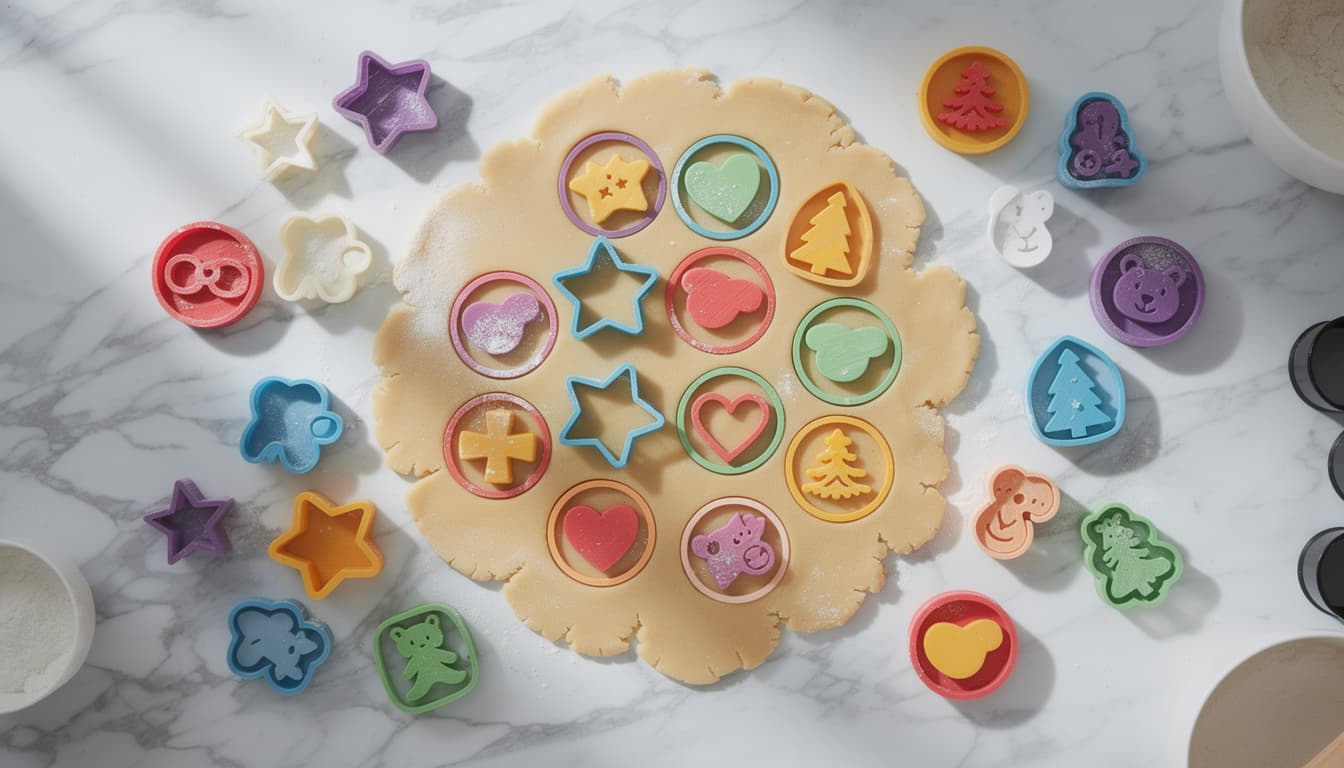
How to Make a Custom Cookie Cutter From Any Image (SVG for 3D Printing)
Turn any logo, pet silhouette, or character outline into a 3D-printable cookie cutter in minutes. Here is the full workflow, file prep tips, and an SVG generator for CakeyTops members.
Last updated 8 min readBy CakeyTops Team
Generic Etsy cookie cutters limit your bakery to the shapes everyone else has. A custom cutter — your client's logo, a child's favourite character outline, your bakery signature shape — sets your work apart and lets you charge a premium. This guide walks through turning any image into a print-ready SVG cutter, then producing it via 3D print or laser cut.
Why custom cookie cutters are worth the effort
Standard cookie cutter shapes cap your decorating ceiling. You can ice them beautifully, but the silhouette is the same one another decorator across town is also using. Custom cutters change three things at once:
Your work is unmistakably yours — clients photograph cookies based on shape first, decoration second.
You charge a premium — custom-shape sets command 30–60% more than standard-shape sets.
Repeat orders — corporate clients order the same logo cutter shape over and over.
The three production routes for custom cutters
Custom cookie cutter production options
Method
Cost per cutter
Time to make
Best for
Home 3D print (PLA)
£0.40–£1.58
1–4 hours
Prototyping, frequent new shapes
3D print service (Shapeways, JLCPCB)
£6–£20
5–10 days
No-printer route, batch orders
Laser-cut acrylic
£12–£32
7–14 days
Premium, clear cutters
Hand-bent copper
£32–£95
1–3 hours skilled labor
Heritage / artisan look
CakeyTops Tool
Cookie Cutter Maker
Upload any image — get a clean SVG outline ready for 3D printing or laser cutting. Included with a CakeyTops membership.
Cookie cutters need a single, closed silhouette. The AI generator works best with images that have:
Clear contrast between subject and background. A dark logo on white works perfectly.
One main subject. Multiple disconnected pieces become multiple cutters.
No fine internal detail. Cookie cutters cut the outline only — interior detail comes from icing.
A reasonable smallest dimension. Tiny features (under 5 mm at the final cookie size) won't cut cleanly.
Step-by-step: from image to physical cutter
1
Pick or prepare your image
PNG with a transparent background is ideal. JPEG with a clean contrasting background also works. Logos, pet silhouettes, character outlines, and handwritten initials are all popular starting points.
2
Upload to the cookie cutter generator
Open the CakeyTops cookie cutter maker and drop your image in. The tool automatically traces the outline and converts it to a clean SVG path.
3
Adjust thresholds and smoothing
If the trace catches too much background, raise the threshold. If it loses fine detail, lower it. Smoothing rounds out jagged edges that come from pixel-step interpretation.
4
Set the cutter size
Decide the final cookie size — most cutters land between 2.5 inches (small decorated cookies) and 4.5 inches (large statement cookies). The SVG export scales to your chosen dimension.
5
Download the SVG
Save the file. SVG is the universal format for both 3D slicers and laser cutting — no conversion needed.
6
Choose your production route
For 3D printing, import the SVG into a design tool like Tinkercad or Cura, extrude it to 12–15 mm tall, add a 6 mm wide top rim for finger pressure, and slice. For laser cutting, send the SVG directly to a service like Ponoko, Sculpteo, or your local maker space.
7
Test cut a cookie
Always test the first cutter with a single cookie before going into production. Look for clean release from the dough, no sticking, and stable finger pressure on the rim. Adjust the design and reprint if needed.
3D printing your cutter at home
A budget home 3D printer (£119–£237) prints cookie cutters in PLA plastic for about £0.40 in material. Recommended settings:
Material: Food-safe PLA (most PLA is food-contact safe; check the spec)
Layer height: 0.2 mm (faster) or 0.16 mm (smoother edge)
Infill: 100% — these are thin walls, no reason to underfill
Wall thickness: 1.2 mm for the cutting edge, 4–6 mm for the top rim
Cutter height: 12–15 mm — enough to cut through dough cleanly without compressing
If you do not own a printer yet, a beginner machine pays for itself within a few custom orders. We cover what to look for, and the food-safe PLA rules, in the best 3D printer for cookie cutters.
Recommended Supply
The 3D printer we recommend for cutters
A beginner-friendly printer that pairs directly with the Cookie Cutter Maker — generate the outline, then print the cutter at home in undyed PLA.
Affiliate disclosure: As an Amazon Associate I earn from qualifying purchases.
Used in our kitchenPrinting hardware
Anycubic Kobra X 3D Printer
A beginner-friendly 3D printer for turning the SVG outlines from our Cookie Cutter Maker into real cutters at home.
This is the natural partner to the cookie cutter maker: you generate the outline, this prints the cutter. It is aimed at beginners and families with sub-hour setup, auto-levelling, and a 260mm bed big enough for large statement cutters. For cutters, load undyed white or natural PLA — pigments in coloured PLA can contain heavy metals.
Why we recommend it
You do not need to be a 3D-printing expert to use it, and once it is set up each cutter costs only pennies in PLA, so custom shapes stop being an Etsy purchase and become something you make on demand.
Printing Cookie Cutter Maker SVGs into physical cutters
Beginners and families new to 3D printing
Making custom cutter shapes on demand instead of buying them
Acrylic cutters (typically clear or coloured 3 mm acrylic) look more premium than printed plastic and last indefinitely. The downside is cost — £12–£32 per cutter from a service vs £0.40 at home. Best for:
High-end client work where the cutter is part of the deliverable
Logo cutters used on every order (the cost amortises quickly)
Selling cutter sets to other bakers
Common image-to-cutter pitfalls
Open paths instead of closed shapes
A cookie cutter must be a closed loop — your dough needs to be enclosed by the cutter wall. The generator handles this automatically, but if you're editing the SVG by hand in Inkscape or Illustrator, ensure every path is closed.
Detail too small for dough
Anything under 4–5 mm at the final cookie size won't hold its shape in cookie dough. Sharp inside corners attract dough and tear when you lift the cutter. Soften any inside angles to gentle curves.
Trademarked characters
Disney, Marvel, sports leagues, and major brands all enforce trademarks aggressively. Custom cutters of these characters can land you in legal trouble even if you're making them for personal use. Stick to original designs, public domain images, and properly licensed work.
Beyond cookie cutters: other uses for image-to-SVG
The same SVG outline you generate for a cookie cutter is useful for:
Cake stencils — laser cut from food-safe plastic, used with airbrushing or buttercream pressing
Royal icing transfers — print the outline, place wax paper over it, pipe royal icing along the line
Fondant cutters — same shape, used for fondant decorations instead of cookies
Cake topper templates — pair with the CakeyTops cake topper maker to create a matching topper for your custom-shape cookies
Frequently Asked Questions
Can I make a cookie cutter from any image?+
Almost any image with a clear silhouette can become a cutter. Logos, pet silhouettes, character outlines, and handwritten initials all work well. Images with very fine internal detail (the detail won't transfer to a cutter) or with multiple disconnected pieces (each becomes a separate cutter) need adjustment first.
Do I need a 3D printer to make custom cookie cutters?+
No. Once you have the SVG file, you can send it to a 3D print service like Shapeways or JLCPCB (£6–£20 per cutter delivered) or to a laser cutting service for premium acrylic cutters (£12–£32). A home 3D printer is the cheapest route at scale but not required to start.
Are 3D printed cookie cutters food-safe?+
PLA plastic — the most common 3D printing material — is considered food-safe for short contact like cookie cutting. Always hand-wash (heat from a dishwasher warps PLA), inspect for layer-line wear, and replace cutters every 6–12 months of regular use.
How tall should a cookie cutter be?+
Most home cookie cutters are 12–15 mm tall — deep enough to cut through standard rolled cookie dough without the dough riding up over the rim. Taller cutters (20 mm+) work for thicker doughs and gingerbread.
What file format do I need for laser cutting?+
SVG is the universal standard for laser cutting services. Some accept DXF or AI as alternatives. The CakeyTops cookie cutter maker exports SVG by default — no conversion needed.
Put the guide into practice
Use the tool from this guide
Open the relevant CakeyTops tool and put the advice above to work straight away.