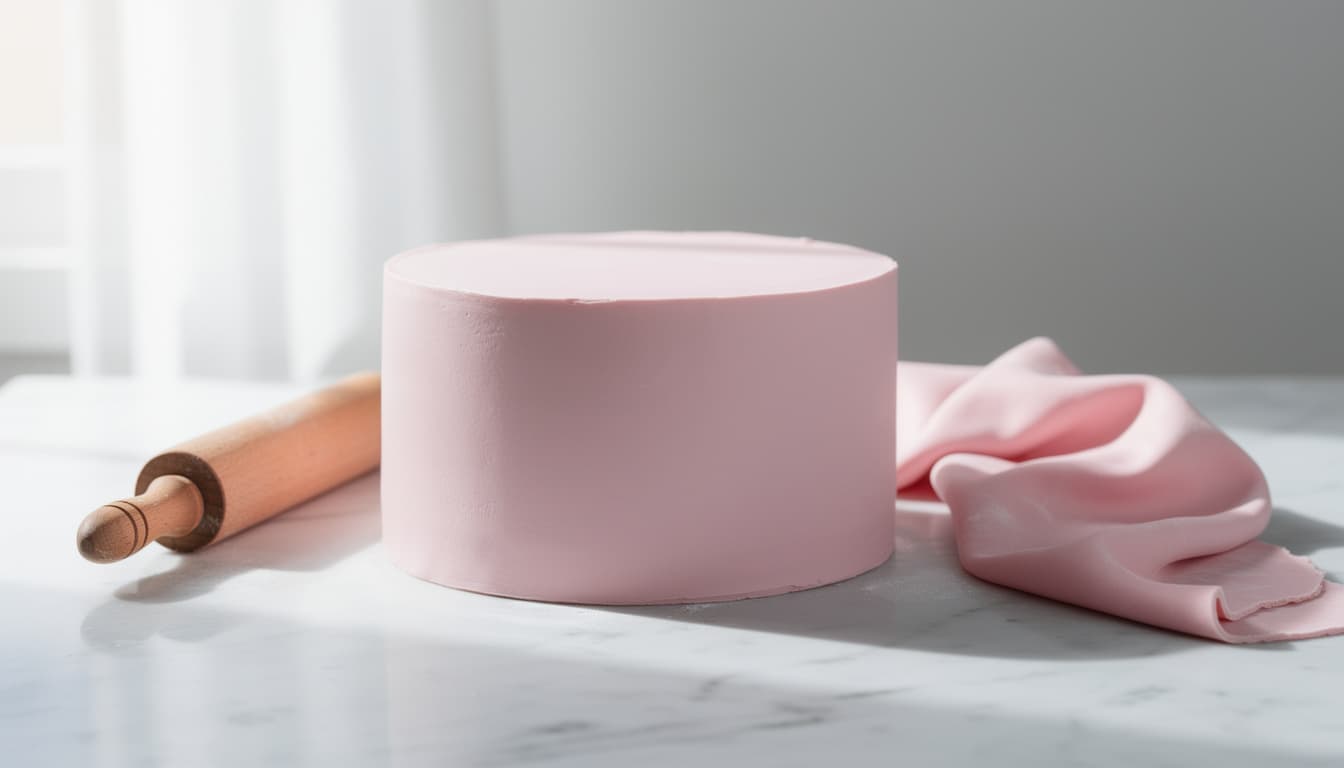
How Much Fondant to Cover a Cake: The Complete Weight Chart
Running out of fondant mid-cake is the professional decorator's recurring nightmare. Use this chart, coverage formula, and free calculator to get it right every time.
Last updated 9 min readBy CakeyTops Team
Running out of fondant halfway through covering a cake is the recurring nightmare of every decorator. This guide gives you the exact weight of fondant needed for every cake size and tier configuration, the rolling-diameter formula, and a calculator that does the maths so you only ever buy or make what you need.
The fondant rolling rule that prevents disasters
To cover a cake cleanly with fondant, your rolled sheet needs to be at least:
Cake top diameter + (2 × cake height) + 4 inches
For an 8-inch round cake that's 4 inches tall: 8 + (2 × 4) + 4 = 20 inches across
That extra 4 inches is your safety margin for trimming. Roll it smaller than this and you'll fall short on the side of the cake during draping — there's no fix for this once you start.
Fondant weight by cake size (3–4 mm thickness)
Fondant required by cake size (covering top + sides at 3–4 mm)
Cake size
Fondant needed
Roll to
4 in round × 4 in tall
300 g
14 in
6 in round × 4 in tall
500 g
18 in
7 in round × 4 in tall
625 g
19 in
8 in round × 4 in tall
750 g
20 in
9 in round × 4 in tall
900 g
21 in
10 in round × 4 in tall
1.1 kg
22 in
12 in round × 4 in tall
1.4 kg
24 in
6 in square × 4 in tall
600 g
18 in
8 in square × 4 in tall
900 g
20 in
10 in square × 4 in tall
1.3 kg
22 in
Free Tool
Fondant Calculator
Pick your cake size and shape — get exact fondant weight, rolling diameter, and tier-by-tier totals.
Tiered cake fondant — calculate each tier separately
There is no scaling formula that works across tiers — each tier has different dimensions and fondant doesn't recycle cleanly between rolls. Add the per-tier amounts and add a buffer for tier borders if you're using fondant ribbons or bows.
Example: a 3-tier cake (6 + 8 + 10 in, all 4 in tall):
6" tier: 500 g
8" tier: 750 g
10" tier: 1,100 g
+ 250 g buffer for ribbons / decorations
Total: 2.6 kg
How fondant thickness changes the maths
The chart above assumes 3–4 mm — the most common professional thickness. If you roll differently:
2 mm thin (modern smooth finish): reduce weight by 30%
3 mm standard (most common): use the chart
4 mm classic (forgiving for beginners): use the chart
5 mm rustic / sculpted: add 20%
For wedding cakes that must hold sharp edges, professionals often use 3 mm. For children's cakes and beginners, 4 mm gives more forgiveness.
Sugarpaste, modelling paste, and gum paste — different jobs
Modelling paste — for figures and small decorations. Holds shape, dries firm.
Gum paste / flower paste — for sugar flowers and lace. Dries rock-hard, doesn't eat well.
The chart above is for fondant / sugarpaste only. Modelling paste needs are minimal (50–200 g for a typical figure); gum paste needs vary wildly by flower complexity.
Covering a board with fondant
Fondant cake boards add a clean professional finish. To cover a round board:
10-inch round board: 250 g
12-inch round board: 350 g
14-inch round board: 450 g
16-inch round board: 600 g
Roll the fondant to the board diameter + 2 inches, then trim flush after laying it across.
Fondant decoration estimates
Beyond covering the cake, common fondant decorations need:
Tier ribbon (1 in tall, around an 8-inch tier): 50 g
Bow (medium): 80–120 g
Cut-out shapes (12 small): 30–50 g
Quilted / textured panels: add 25% to your covering weight
Sculpted figure (small character): 100–250 g of modelling paste
How long fondant takes to roll out
Allow real time for fondant work — this is where most decorators underestimate the clock:
Kneading and colouring: 10–20 minutes per kilogram
Rolling out a single tier: 5–10 minutes
Lifting and draping: 2–4 minutes
Smoothing: 5–10 minutes
Trimming: 3–5 minutes
Total per tier: 25–50 minutes. For a 3-tier cake, plan a full afternoon.
Storing leftover fondant
Wrap leftover fondant tightly in plastic film, then in an airtight container or zip-top bag with the air pressed out. Store at room temperature (never refrigerated — condensation ruins fondant). It keeps for 2–3 months.
Coloured fondant will keep its colour for about 4–6 weeks; after that the gel colour starts to bleed and the fondant becomes harder to re-knead.
Recommended Supply
Colour your fondant
Knead a little concentrated gel paste into white fondant for deep, even colour without the stickiness that liquid colour causes. A small set covers most shades you will mix.
Affiliate disclosure: As an Amazon Associate I earn from qualifying purchases.
Used in our kitchenDecorating supplies
Sugarflair Rainbow Gel Food Colours (Set of 6)
Six concentrated gel food colours for buttercream, royal icing, sugarpaste, and cookie painting.
Sugarflair is a UK decorating staple. This six-colour starter set is highly concentrated, so a cocktail-stick dab goes a long way, and the colours deepen as they dry — which is exactly what you want for strong buttercream tones and deep PYO palette colours that still read after a wet brush.
Why we recommend it
The set we would point a new decorator to before they commit to forty individual pots — enough to mix most shades you actually need.
Colouring buttercream, royal icing, and sugarpaste
How much fondant do I need to cover an 8-inch cake?+
For a standard 8-inch round cake that is 4 inches tall, you need approximately 750 g (1.65 lb) of fondant rolled to 3–4 mm thickness, with the sheet rolled to about 20 inches across.
How thick should fondant be rolled?+
The standard professional thickness is 3–4 mm. Thinner (2 mm) gives a sleek modern look but is harder to drape without tearing. Thicker (5 mm+) is more forgiving but tastes too sweet on each bite.
How big should I roll my fondant?+
Use the formula: cake top diameter + (2 × cake height) + 4 inches. For an 8-inch cake that is 4 inches tall, roll to 20 inches across (8 + 8 + 4 = 20).
How much fondant for a 3-tier wedding cake?+
A 3-tier wedding cake with 6, 8, and 10-inch tiers (all 4 inches tall) needs approximately 2.4 kg of fondant for covering, plus 200–400 g extra for ribbons, bows, and decorations. Buy or make at least 20% more than calculated for waste.
Can I refrigerate fondant?+
No. Refrigerating fondant creates condensation, which makes the surface sticky and ruins the finish. Store fondant tightly wrapped in plastic at room temperature for up to 2–3 months.
Ready to design your own cake toppers?
Free to use, no software to install, and every export comes out at a crisp 300 DPI.